If you are building an FTTH network with more than four outputs per splitter, choose a PLC splitter. If you only need a 1×2 or 1×4 split, or an uneven ratio such as 90/10, an FBT coupler is usually the cheaper and more flexible choice. The rest of this guide explains why.
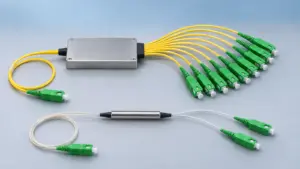
Fiber optic splitters are passive devices that divide one optical signal into several outputs, so a single fiber from the central office can serve many subscribers. Two technologies dominate the market: the PLC splitter and the FBT coupler. They look similar from the outside, but they behave very differently inside a network.
How each one works
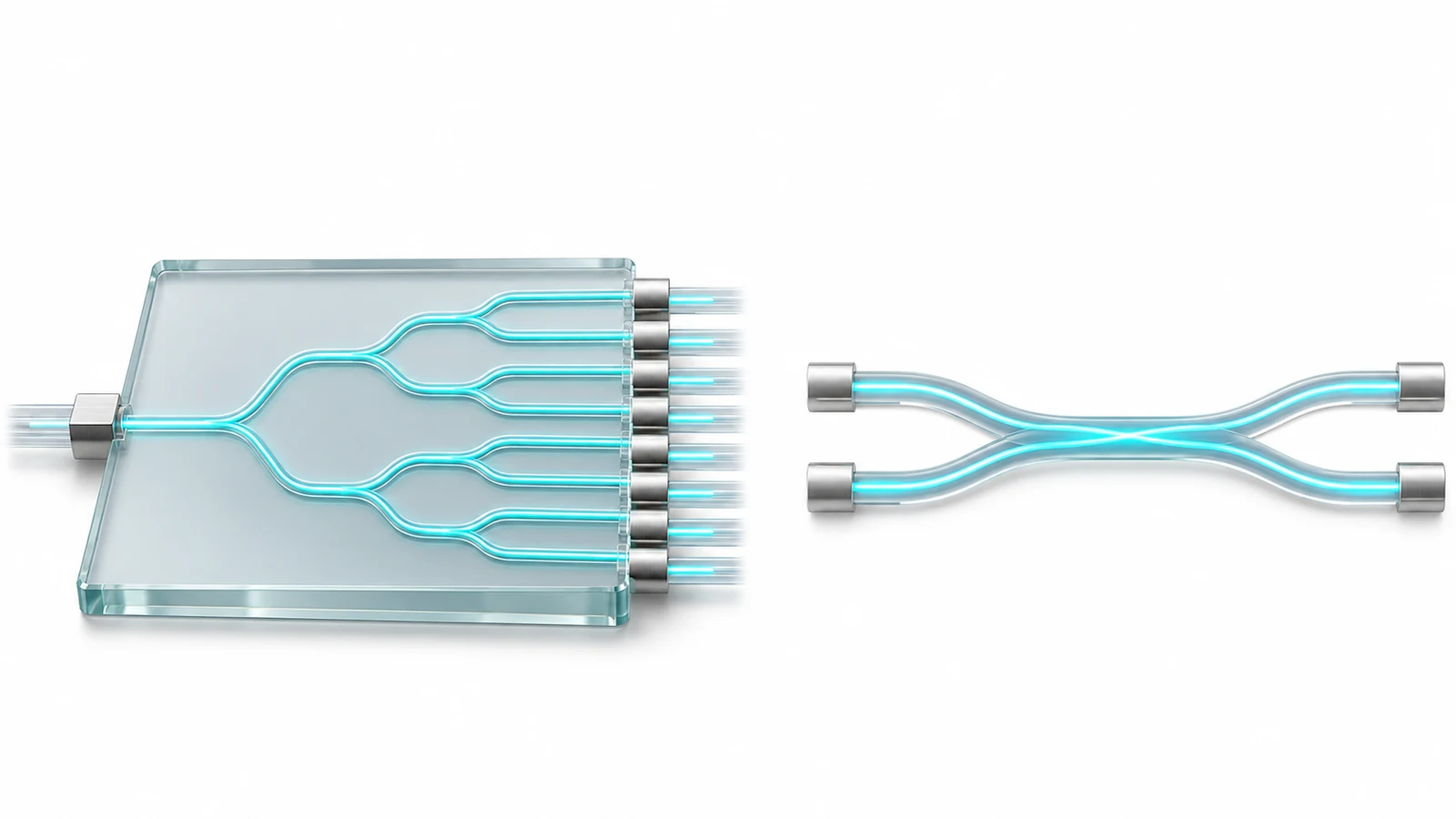
An FBT (Fused Biconical Taper) coupler is made by twisting two or more fibers together, heating them and pulling until the cores fuse. Light is shared between the fibers in the fused zone. The split ratio depends on how long the fusion is carried out, which is why FBT couplers can be made in uneven ratios.
A PLC (Planar Lightwave Circuit) splitter is built on a silicon or glass chip. Optical waveguides are etched into the chip using semiconductor processes, and the light is divided at each branch point. Fiber arrays are then aligned and attached to both ends of the chip. Because the split is defined by the chip design, the output power is equal on every port.
Side-by-side comparison
| Feature | PLC splitter | FBT coupler |
|---|---|---|
| Split ratio | Equal split (1×2 up to 1×64, 2×N) | Equal or custom (e.g. 50/50, 70/30, 90/10) |
| Operating wavelength | Wide, 1260–1650 nm | Narrow, around 1310, 1490 or 1550 nm |
| Uniformity | Excellent, small port-to-port difference | Weaker, grows with split count |
| Typical split count | 1×4 and above, up to 1×64 | Up to about 1×4, rarely beyond 1×8 |
| Insertion loss (1×4 / 1×8) | About 7.2 dB / 10.5 dB | Similar at 1×2, worse at higher counts |
| Temperature stability | Stable across a wide range | More sensitive to temperature |
| Cost | Higher at low port counts, lower per port at high counts | Lower at 1×2 and 1×4 |
Typical insertion loss figures are approximate and vary by manufacturer and connector type. Always check the datasheet for your exact product.
When to choose a PLC splitter
- Passive optical networks (GPON, EPON, XGS-PON). These systems use several wavelengths at once (1310 nm upstream, 1490 nm downstream, and 1550 nm for video overlay). A PLC splitter handles all of them without re-tuning.
- High split counts. For 1×8, 1×16, 1×32 or 1×64, PLC is the only practical option. Output uniformity is what keeps every subscriber’s signal level within the OLT’s tolerance.
- Outdoor and wide-temperature sites. The chip-based design keeps performance stable through seasonal changes.
- Large rollouts. Standardizing on PLC simplifies planning, because every output port gives the same power.
When to choose an FBT coupler
- Small splits at the lowest cost. For 1×2 or 1×4 links, FBT couplers are often cheaper.
- Uneven ratios. Need to tap 5% or 10% of the signal for monitoring, or feed a near and a far branch differently? FBT lets you set the ratio, while PLC cannot.
- Single-wavelength systems. Test setups, CATV trunk taps and some sensor networks work fine within a narrow wavelength window.
Packaging matters too
Choosing the technology is only half the decision. The splitter also has to fit where it will be installed:
- Steel tube (bare-fiber) type for splice closures and small boxes where space is tight.
- Plastic box (ABS) type for terminal boxes and indoor wall-mount enclosures.
- Cassette and LGX type for distribution frames and ODF racks.
- Rack-mounted type for central office and data room cabinets with high port density.
Connector choice (SC/APC, SC/UPC, LC/APC) should also match the rest of your network. APC connectors are standard for PON and CATV because they give better return loss.
A quick decision guide
- Count the outputs you need per splitter. Four or fewer → consider FBT; more than four → PLC.
- Check the wavelengths used by your equipment. Several wavelengths → PLC.
- Check whether you need an unequal ratio. If yes → FBT.
- Choose the package and connector for your enclosure.
- Request a datasheet with insertion loss, uniformity and return loss before ordering in volume.
Find the right splitter at Vichin Fiber
Vichin Fiber has manufactured passive fiber products since 2009 and exports to more than 50 countries. Our Fiber Optic Splitter range includes cassette-type, rack-mounted, LGX, plastic box and steel tube PLC splitters, plus FBT couplers, available with SC and other connector types. Not sure which one fits your project? Contact our team with your split ratio, connector type and quantity, and we will recommend a solution.