A fiber optic cable that passes inspection at the factory but fails after two years in the field costs far more than the cable itself. That is why serious manufacturers test at every stage, not just at the end. Here is how quality control works at Vichin Fiber, from the first spool of raw material to the container on its way overseas.
Why testing matters for export buyers
Overseas buyers cannot visit every factory, and a defective batch is expensive to ship back. Testing gives buyers three things: proof that the cable meets the specification, consistency from batch to batch, and traceability if something ever goes wrong. For networks that must last 20 years or more, these are not optional extras.
Step 1: Control the raw materials
Cable quality starts before production. Vichin controls its raw materials itself, so the fiber, strength members, jacketing compounds and other components can be checked and kept consistent. Incoming materials are inspected for:
- Fiber attenuation, geometry and color coding
- Strength member tensile properties (FRP, aramid yarn, steel wire)
- Jacket compound properties such as hardness and flame retardancy (for example LSZH)
- Gel and water-blocking materials, where used
Materials that fail incoming inspection never reach the production line.
Step 2: Produce in a controlled environment
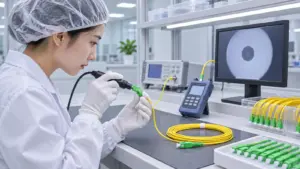
Core components, including connectors, splitters and patch cords, are assembled in dust-free workshops. This matters because a single dust particle on a connector end face can raise insertion loss or damage the surface when two connectors are mated. Checking during production helps catch problems early rather than at the end.
Step 3: Optical testing
Optical performance is checked on finished products:
| Test | What it checks | Applies to |
|---|---|---|
| Attenuation (OTDR / power meter) | Signal loss along the fiber, and any breaks or bad splices | Optical cables |
| Insertion loss | Loss added by a connector or splitter | Patch cords, splitters, adapters |
| Return loss | Light reflected back toward the source | APC / UPC connectors, splitters |
| End-face inspection | Scratches, dirt and cracks on connector ferrules, checked under a microscope | Connectors, patch cords |
| Splitting ratio and uniformity | Evenness of power across output ports | PLC splitters, FBT couplers |
Step 4: Mechanical and environmental testing
A cable has to survive installation as well as operation. Typical tests include:
- Tensile strength: the cable is pulled at its rated load while attenuation is monitored.
- Crush and impact: simulates being stepped on, hit or squeezed during installation.
- Bending and torsion: repeated bending checks that the fiber does not break or lose signal.
- Temperature cycling: the cable is held at high and low temperatures, with attenuation measured throughout.
- Water penetration and jacket aging: important for outdoor and duct cables.
Step 5: Final inspection, labeling and packing
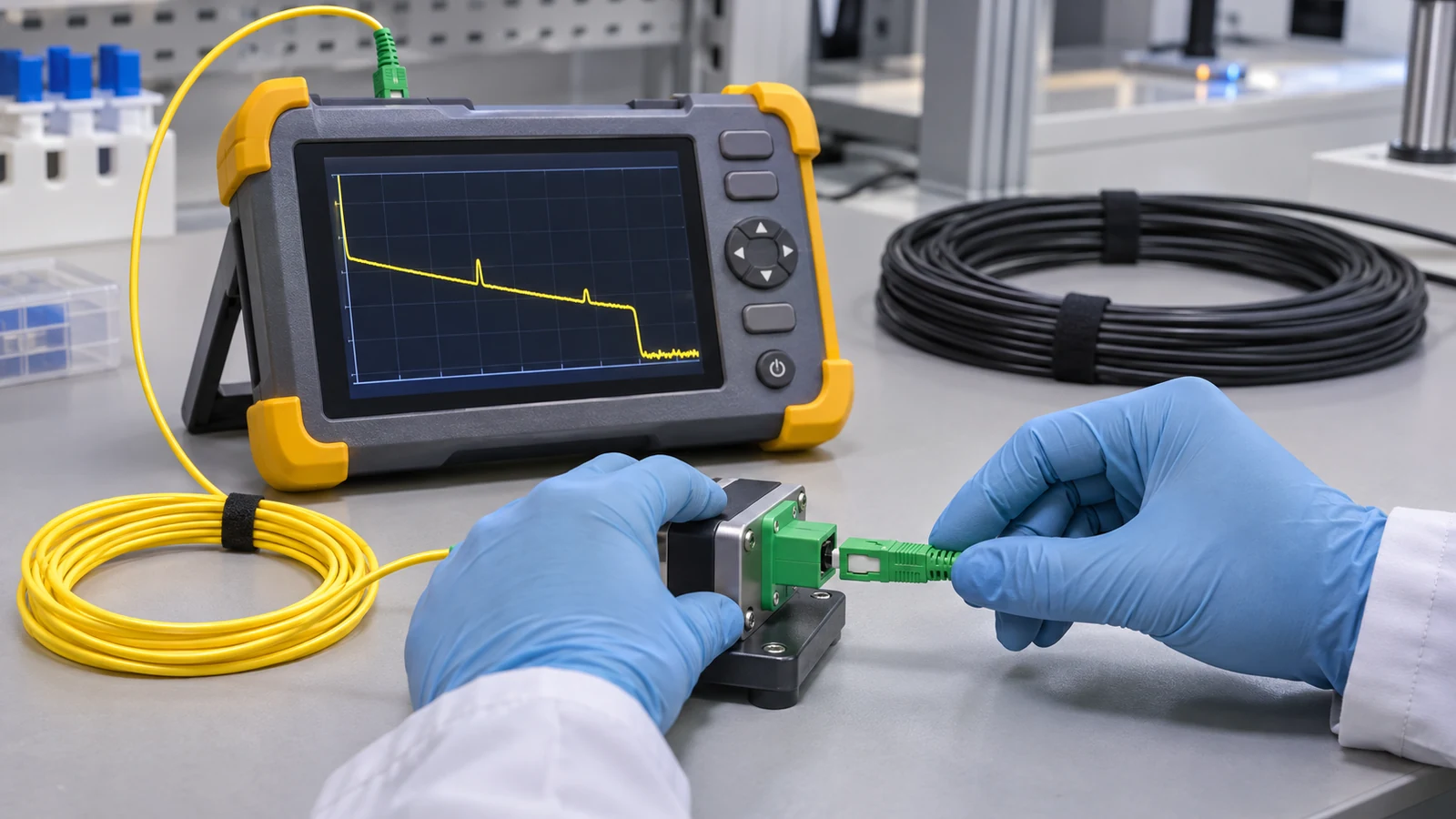
Before shipping, each batch goes through a final check:
- Visual inspection of jacket, markings and length
- Optical testing of the finished products
- A check of quantity and specification against the order
- Reel, carton and pallet packing that protects the cable in a long sea voyage
- Clear labeling for identification
Certifications and standards
Vichin’s products serve China’s core communication networks and customers in over 50 countries, including the US, UK, Germany and Brazil.
What buyers can ask for
When evaluating any fiber optic cable supplier, we suggest asking for:
- Test reports for the exact product and batch (not only generic datasheets)
- A sample order before the first volume order
- A list of certificates and the standards each product meets
- Details of how the manufacturer handles complaints and replacements
A supplier who answers these questions clearly and quickly is usually one that tests properly.
Work with a factory that tests what it ships
Explore our cable series, fiber optic connectors and cable assemblies, or learn more about Vichin Fiber. To discuss your requirements, contact us and our team will respond with the details.