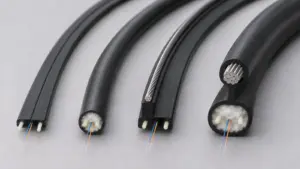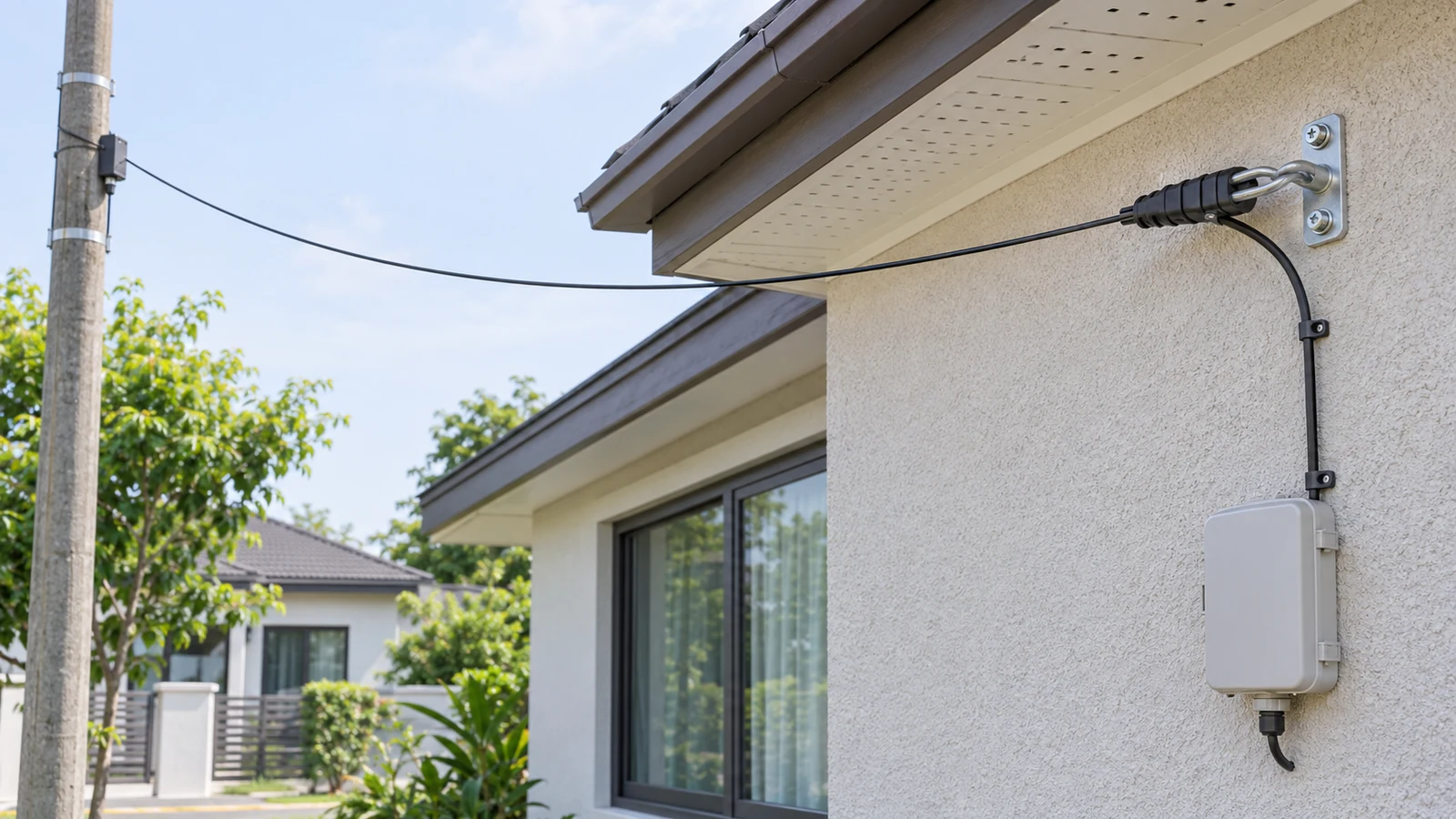
The right FTTH drop cable depends on how it will be installed. Use a flat bow-type cable for short indoor or duct runs, a round cable where flexibility matters, and a self-supporting or figure-8 design when the cable must span poles or building fronts without a separate messenger wire.
The drop cable is the last link in a fiber network. It runs from the distribution point or terminal box to the subscriber’s home or business, so it faces rooftops, walls, poles, weather and sharp bends. Choosing the wrong type leads to broken fibers, slow installation and costly call-backs. This guide compares the four most common types so you can choose with confidence.
1. Flat bow-type drop cable (GJXFH)
The bow-type cable has a flat, oval cross-section with two parallel strength members, usually FRP or steel wire, on either side of the fiber. It is easy to strip and easy to route along walls.
- Best for: indoor and building-entry runs, short duct or conduit drops, riser cables.
- Typical cores: 1, 2 or 4 fibers (for example the GJXFH 1 core, 2 core and 4 core types).
- Strengths: low cost, quick to terminate, and lightweight.
- Limits: not designed to span long distances on its own, so it needs support when used outdoors.
2. Round drop cable
A round cable, such as a 5 mm 1-core FTTH drop cable, has a circular jacket and strength members placed evenly around the fiber. It handles bending and twisting in every direction, which makes it popular for apartment buildings.
- Best for: access cables inside buildings, pulling through conduits, and routes with many turns.
- Strengths: flexible in all directions, smooth jacket, easy to pull through ducts.
- Limits: thicker than a flat cable, so it takes more space in crowded raceways.
3. Self-supporting bow-type drop cable
This is the bow-type cable with a steel messenger wire attached, so it can hang between supports without extra hardware. The steel wire carries the tension and the fiber unit stays relaxed.
- Best for: aerial drops from a pole to the house, typically with spans of up to several tens of meters, depending on the design and local rules.
- Typical cores: 1 core up to 12 cores for the larger figure-8 types.
- Strengths: one cable does the job of a cable plus messenger, which saves installation time.
- Limits: the steel member means it is heavier, and it needs proper grounding and clamps.
4. Figure-8 aerial drop cable (GJYXFCH)
Figure-8 cable has a fiber unit and a steel wire joined side by side by a thin web, which gives it its name. The two halves can be separated, so the messenger is clamped to the pole while the fiber goes into the building. GJYXFCH cables are available with higher core counts, such as 8 and 12 cores.
- Best for: aerial runs with longer spans, and routes where one cable must serve several subscribers.
- Strengths: good tensile strength, widely used in aerial FTTH rollouts.
- Limits: needs hardware designed for figure-8 cable.
Quick comparison
| Cable type | Shape | Typical cores | Main use | Installation |
|---|---|---|---|---|
| Flat bow-type | Flat / oval | 1–4 | Indoor, building entry, short ducts | Wall clips, conduit |
| Round | Circular | 1–2 | Indoor, conduit, many bends | Pulling, conduit |
| Self-supporting bow-type | Flat plus steel wire | 1–4 | Aerial pole-to-house drop | Drop clamps on poles |
| Figure-8 (GJYXFCH) | Figure-8 shape | 4–12 | Aerial, longer spans | Messenger clamped to pole |
Five specifications to check before you order
- Core count. One fiber per home is common, but 2 or 4 cores allow for future services or backup.
- Fiber type. G.657A1 or G.657A2 bend-insensitive fiber is recommended for tight indoor bends, and it is the standard choice for FTTH.
- Tensile strength. Check the short-term and long-term tension ratings against your span length.
- Jacket material. LSZH (low smoke zero halogen) is required in many buildings. PE or UV-resistant jackets suit outdoor use.
- Operating temperature. Confirm the range suits your climate, especially for aerial installations.
Common mistakes
- Using an indoor flat cable outdoors without UV protection or support.
- Ignoring the minimum bend radius during installation, which raises attenuation.
- Choosing the cheapest steel-wire cable for coastal sites where corrosion is a risk.
- Not matching the cable to the clamps and accessories already in stock.
Get the right drop cable from Vichin Fiber
Vichin Fiber supplies a full range of FTTH drop cables including 1 core self-supporting round type, 5 mm 1 core round type, GJXFH flat bow-type and GJYXFCH self-supporting bow-type cables. Tell us your installation method, span length and quantity through our contact page and we will suggest the best fit.